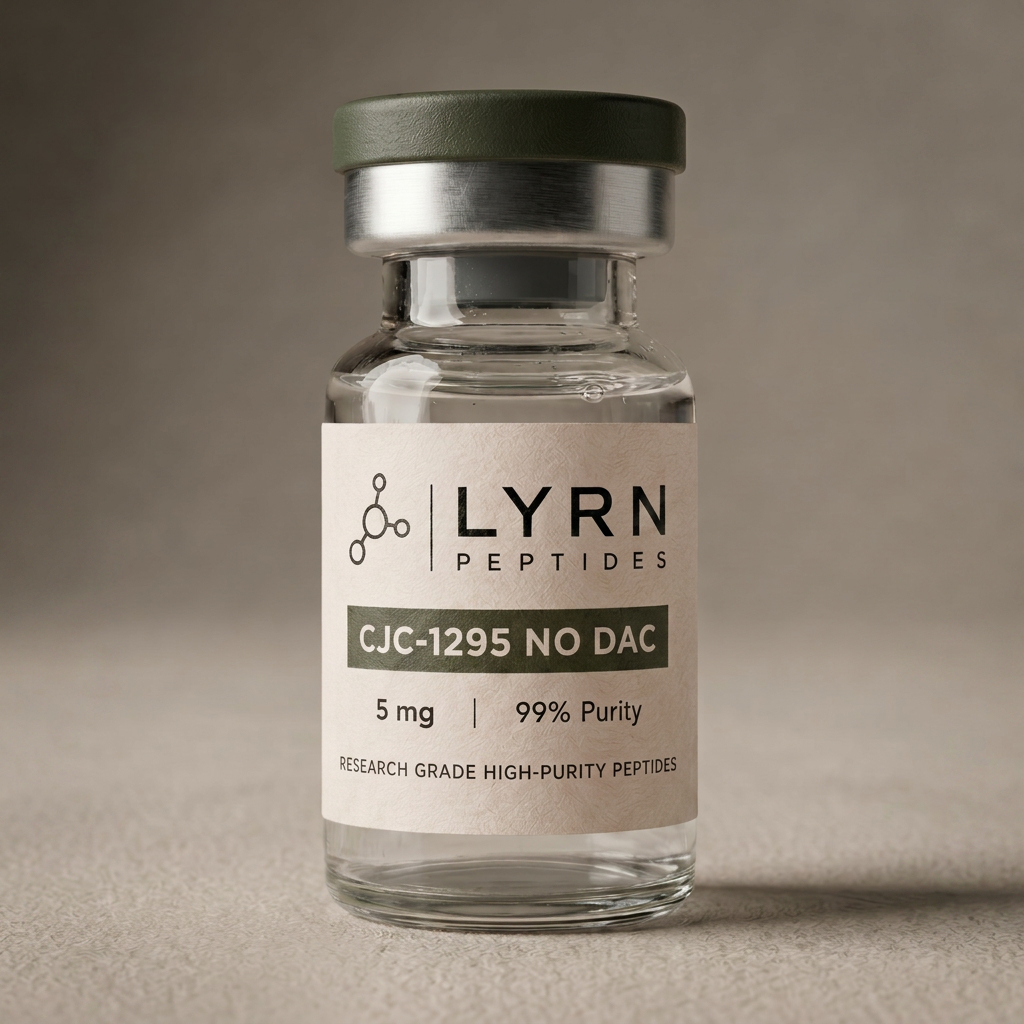
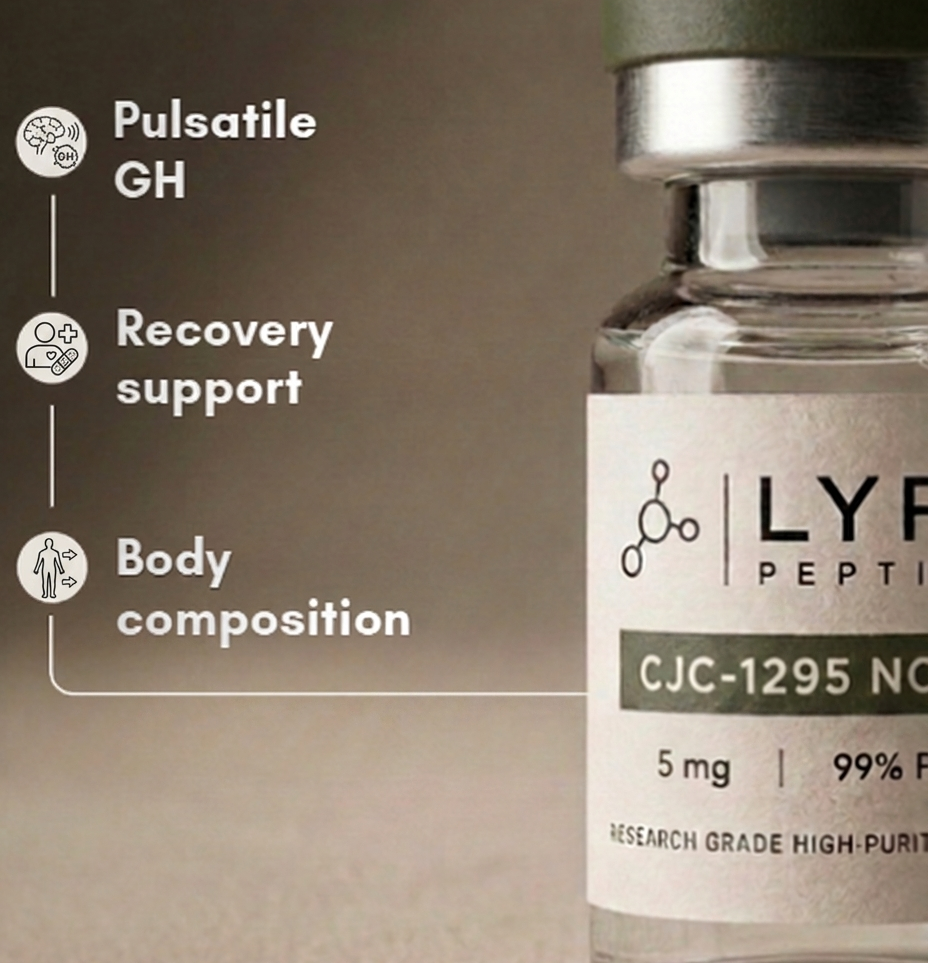
CJC-1295 No DAC is a GHRH analogue designed to support the natural signal that tells the pituitary gland to release growth hormone. The No DAC version has a shorter duration and is positioned around a more targeted, pulsatile signal rather than prolonged multi-day stimulation. Its catalogue role connects recovery, sleep quality, training adaptation and body composition. It can be selected alone or paired with Ipamorelin for two complementary growth-hormone signals.
CJC-1295 No DAC is an analogue of growth hormone-releasing hormone (GHRH). Its function is to signal the pituitary gland to release growth hormone endogenously. It is not a direct form of growth hormone and belongs to a more sensitive hormonal category than recovery peptides.
This means it does not incorporate the Drug Affinity Complex—the element that extends the half-life of CJC-1295 with DAC to several days. The “No DAC” version has a much shorter duration and is used to generate more
precise, pulsatile signals. It is important for the supplier to clearly confirm which version the vial contains.
By supporting the endogenous release of GH, it is linked to recovery, deep sleep, training adaptation, and body composition. Its benefits are neither immediate nor stimulating; rather, it aims to foster a more favorable physiological environment. Results depend heavily on sleep, nutrition, training, and hormonal context.
The main difference lies in the duration of the signal. With DAC, it can be sustained for several days; without DAC, it acts for hours and more closely approximates a pulsatile pattern. This difference alters the entire strategy and should not be treated merely as a variation in quantity.
CJC-1295 mimics the GHRH signal. Ipamorelin acts on the ghrelin receptor in the pituitary gland. Both can increase GH release, but they do so via different pathways; therefore, they are considered complementary rather than
equivalent.
This is because one signal provides a stimulus similar to GHRH, while the other reinforces the response from the ghrelin receptor. The combination aims for a more complete release of endogenous GH. Nevertheless, it may be preferable to keep them separate when one needs to be adjusted without modifying the other.
Yes, when the aim is to specifically target the GHRH pathway or assess the response without introducing another secretagogue. The combination is not mandatory. Starting with a simpler tool can provide greater clarity and fewer
variables.
The 5 mg and 10 mg figures indicate the total amount of product contained in each vial, not a recommendation for use.
A larger presentation may offer a greater quantity or more flexibility, but it is not automatically the right choice.
The choice should depend on the objective, the protocol format, and individual assessment.
You will be kept up to date with all our latest news.